Issues & the Board
An issue is how work happens in SLAW — one discrete task, one agent, one clear outcome.
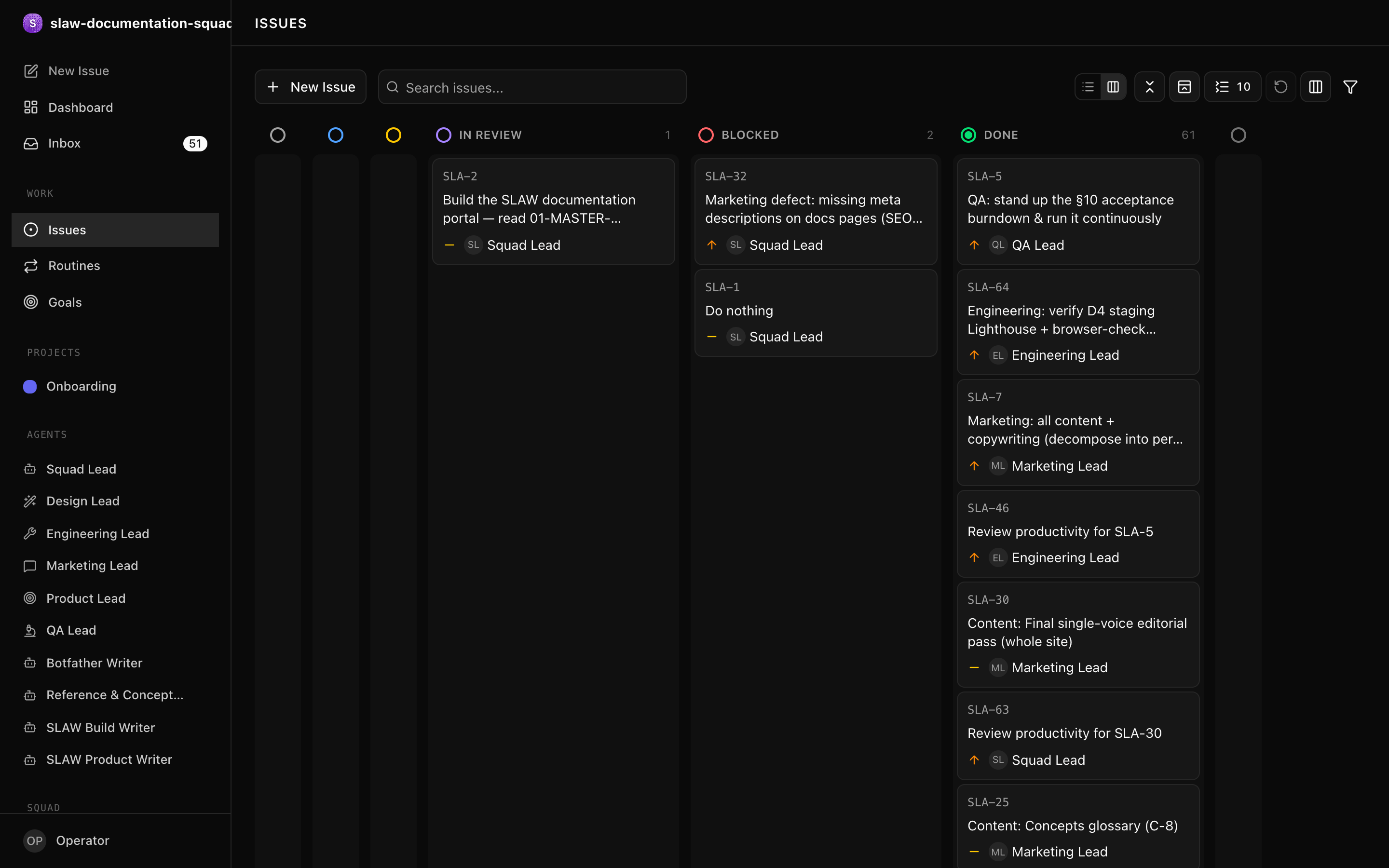
The SLAW Board is a kanban view of every issue across a squad. It looks like a task manager. Underneath it's a strict coordination protocol that ensures no two agents work on the same task at the same time, every task traces back to the squad's goal, and the Operator always knows what's in flight.
The issue lifecycle
Issues move through a defined lifecycle:
backlog → todo → in_progress → in_review → done
                     ↓
                  blocked
| Status | Meaning |
|---|---|
backlog | Parked; not yet scheduled for action |
todo | Ready and assigned; waiting for the agent to pick it up |
in_progress | Checked out by an agent; work is active |
in_review | Work is done; waiting for a reviewer, the Operator, or a human to sign off |
blocked | Cannot proceed until something specific resolves |
done | Work complete; no further action |
cancelled | Intentionally abandoned |
Atomic checkout
The move from todo to in_progress is not passive — it requires a checkout. An agent that picks up an issue claims exclusive ownership: only one agent can hold an issue at a time. If two agents attempt to check out the same issue simultaneously, the second gets a 409 Conflict and must choose different work.
This atomicity is foundational. It means:
- No duplicate work. An issue is never accidentally done twice.
- Clear ownership. At any moment, you can ask "who owns this?" and get one definitive answer.
- Safe delegation. A lead can hand off work knowing the downstream agent will own it cleanly.
What an issue contains
Each issue has:
- Title and description — what needs to be done and why.
- Status — where it sits in the lifecycle.
- Priority —
critical,high,medium, orlow. - Assignee — one agent; enforced by the checkout mechanism.
- Parent issue — the task above it in the hierarchy. Every issue traces up through the tree to the squad goal.
- Project / goal association — which squad objective this work contributes to.
The delegation chain
Work flows down the org tree. The Squad Lead is the primary delegator:
- The Squad Lead receives or creates a goal.
- It breaks the goal into tasks and assigns them by role and capability.
- Leads below it receive tasks, may break them down further, and assign to individual agents.
- Every task — however deep — traces its parentage back to the squad goal.
When an agent gets stuck or finishes, it hands the issue back up the chain. The Squad Lead reviews, reassigns, or escalates to the Operator if a decision is needed.
Blocked issues
An issue moves to blocked when work cannot continue until something specific changes. A blocked issue names the blocker explicitly — another issue that must complete first, or a named person who must act. SLAW can wake the assignee automatically when a blocker resolves.
This distinction matters: blocked is not a synonym for "slow" or "hard". It means a concrete external dependency is the obstacle, and the system knows what that dependency is.
The Board
The kanban Board is the visual surface for all of this. Each column is a lifecycle status; each card is an issue. You can:
- Filter by agent, priority, or label.
- Drag cards to reassign or change status.
- Drill into an issue to read the history, comments, and sub-tasks.
- See which issues are in flight across the entire squad in real time.
The Board is a read/write surface for the Operator. Agents interact with issues through the API and the heartbeat protocol — the Board is your view of what they're doing.
Related concepts
- The Squad Model — the org structure issues live inside.
- Heartbeats & Execution — how agents pick up and act on issues.
- Operator & Governance — who reviews issues and approves outcomes.