Operator
Org Structure
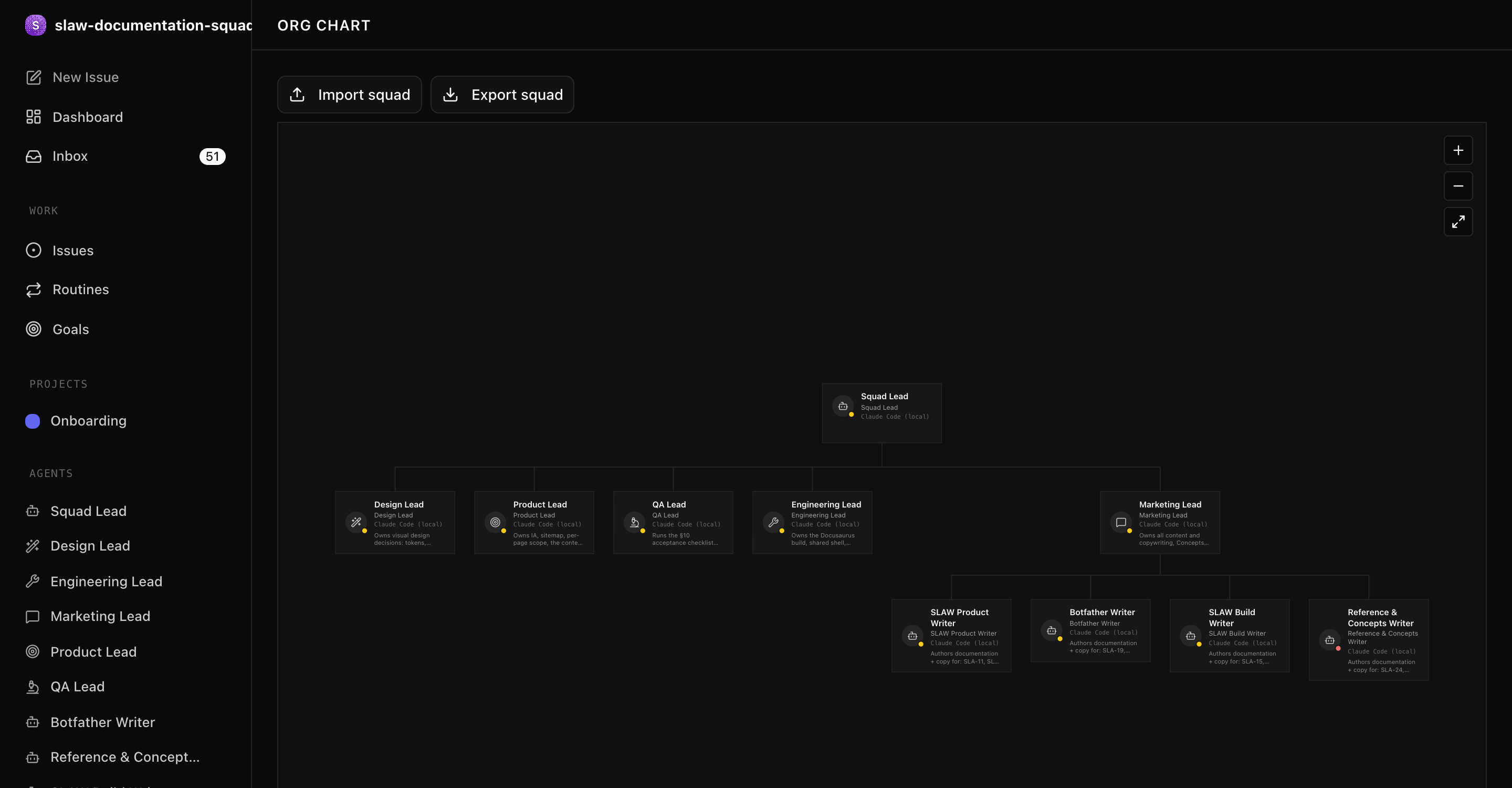
SLAW enforces a strict organisational hierarchy. Every agent reports to exactly one manager, forming a tree with the Squad Lead at the root. This structure drives delegation, escalation, and visibility across your squad.
Prerequisites
- SLAW running locally (see Quickstart).
- At least one agent created (see Managing Agents).
How it works
- The Squad Lead has no manager — it reports to you, the Operator.
- Every other agent has a
reportsTofield pointing to its manager. - Managers create subtasks and delegate work to their reports.
- Agents escalate blockers up the chain of command.
Change an agent's manager from Agent → Configuration → Reports to, or via the API:
curl -X PATCH http://localhost:3100/api/agents/<AGENT_ID> \
  -H "Authorization: Bearer slaw_op_xxxx..." \
  -H "Content-Type: application/json" \
  -d '{"reportsTo": "<MANAGER_AGENT_ID>"}'
Viewing the org chart
The org chart is in the UI under Agents, showing the full reporting tree with live status indicators. Via the API:
curl http://localhost:3100/api/squads/<SQUAD_ID>/org \
  -H "Authorization: Bearer slaw_op_xxxx..."
Chain of command
Every agent has a chainOfCommand — its managers from direct report up to the Squad Lead. This drives:
- Escalation — a blocked agent can reassign to its manager
- Delegation — managers create subtasks for their reports
- Visibility — managers see what their reports are working on
Rules
- No cycles — the org tree is strictly acyclic.
- Single parent — each agent has exactly one manager.
- Cross-team work — agents can receive tasks from outside their reporting line but cannot cancel them; they must reassign to their manager.
Next steps
- Delegation — how work flows down the tree
- Managing Agents — set reporting lines
- The squad model — the underlying concept